






Latest News
- Panasonic Expands Aquarea M Series with New Compact Solution 13/10/2026 New space-saving R290 air-to-water heat pump delivers flexible installation, high-temperature perfor... Read more
- Panasonic Launches Aquarea High-Performance N Series, a Next-Generation Refrigerant Split Solution 13/10/2026 A split heat pump built for the next phase of F-Gas regulation, from 3 to 9 kW Read more
- Panasonic tests indicate nanoe™ X potential to inhibit certain pollen allergen proteins 13/10/2026 Tests across 12 European pollen types highlight the potential of Panasonic air-conditioning units wi... Read more
- Panasonic reaffirms long-term investment in Europe at Chillventa 2026 13/10/2026 Panasonic advances Europe’s heating and cooling transition with lower GWP solutions, smarter energ... Read more
- Panasonic Heating & Cooling Unveils New Brand Identity for Europe 05/10/2026 The new identity signals the next phase of Panasonic’s growth in Europe, supported by significant ... Read more
- Panasonic Heating & Cooling Solutions becomes an official partner of Borussia Dortmund (BVB) 01/10/2026 Panasonic Heating & Cooling Europe and football club Borussia Dortmund Football Club (BVB) have anno... Read more
- More Panasonic News
Panasonic tests indicate nanoe™ X potential to inhibit certain pollen allergen proteins
13/10/2026
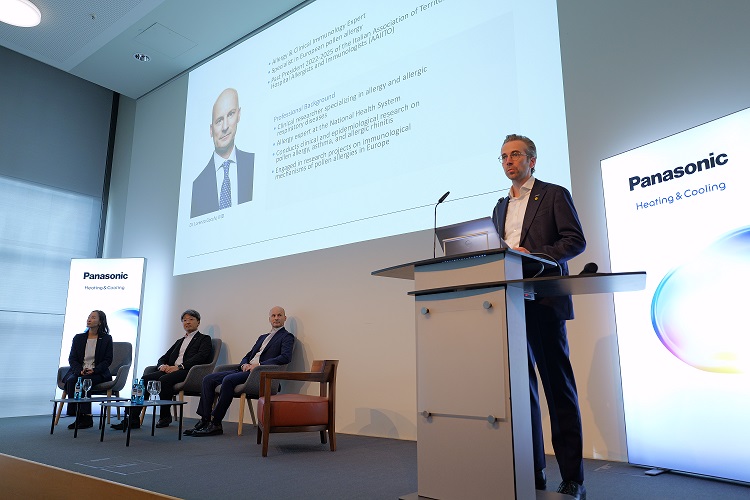
Speaking during Chillventa 2026, Panasonic
unveiled new laboratory findings that indicate the potential of its nanoe™ X
technology, integrated into a wide range of Panasonic residential and
commercial air-conditioning units, to inhibit certain allergenic proteins
associated with pollen species commonly found across Europe under controlled
test conditions.
The research was
conducted in collaboration with Dr Lorenzo Cecchi, MD, a leading European
allergy and clinical immunology specialist with expertise in pollen allergy. It
examines indoor pollen exposure, the technology behind nanoe™ X and the resulting
laboratory observations.
A growing pollen
challenge across Europe
Pollen exposure
is becoming an increasingly serious public health challenge in Europe. The
European Climate and Health Observatory estimates that pollen allergy affects
around 40%[1]
of Europeans, while climate change is contributing to earlier and longer pollen
seasons, higher pollen concentration and increased allergenicity. Together with
air pollution, these trends can intensify allergic and respiratory conditions,
affect quality of life and productivity, and place additional pressure on
healthcare systems[2]. T[LC1] he
challenge does not end outdoors, as pollen can enter buildings through open
windows or carried inside on clothing and hair, contributing to continued
indoor exposure.
Enrique
Vilamitjana, Managing Director of Panasonic Heating & Cooling Europe,
commented: “Improving indoor air quality remains a key focus of our research, with
these findings representing another valuable step in understanding the
potential of nanoe™ X technology to inhibit certain pollen allergens [3].
We will continue working with experts to strengthen the evidence and further
explore how the technology can support improved indoor air quality and greater indoor
comfort.”
New findings for nanoe™ X across grass, tree and weed pollens
The tests bring together results for 12 pollen types relevant to Europe
from grass, trees and weeds[4].
Testing took
place in a room-sized chamber of approximately 23 m³, using a Panasonic
air-conditioning unit equipped with nanoe™ X technology with the pollen sample
positioned outside the direct airflow. Researchers analysed the pollen allergenic
proteins using gel electrophoresis, a technique that separates pollen proteins
by molecular size so that they appear as visible bands.
Across the pollen
types evaluated, laboratory analysis identified weaker bands associated with certain
allergenic proteins following nanoe™ X exposure. The treated samples showed a
faded band after 24 hours, while the untreated sample retained its band[5].
These protein-analysis observations indicate the potential of nanoe™ X
technology to inhibit certain pollen allergens.
Dr Lorenzo
Cecchi, MD, commented: “This is promising technology that could contribute to
better indoor air quality. The tests demonstrated the potential of nanoe™ X
technology to reduce the allergenicity of pollen remaining in the room. Further
study will help to strengthen the evidence.”
Addressing pollen that reaches
indoor spaces
Once indoors,
pollen can remain suspended in the air or settle on soft furnishings such as
curtains, sofas, rugs and bedding, creating a continuing source of exposure.
Panasonic’s nanoe™ X technology uses moisture naturally present in the
air to generate hydroxyl radicals contained within nano-sized water particles.
These particles disperse through the indoor environment and can reach pollen
suspended in the air as well as pollen that has settled on fabrics and
surfaces. When the hydroxyl radicals come into contact
with pollen, they act on its associated proteins by altering their
structure. Laboratory analysis indicates the potential of nanoe™ X technology
to inhibit certain pollen allergenic proteins.
For the HVAC
sector, the research is relevant to a broad range of residential and commercial
applications. Panasonic integrates nanoe™ X technology across much of its room
air-conditioning line-up, as well as selected commercial air-to-air indoor
units and fan coils, providing consultants, installers, and
building operators options for incorporating the technology into homes and a
variety of occupied commercial spaces[6].
See link to more information
about nanoe X technology. For more information about Panasonic’s range of heating, cooling, please
visit https://aircon.panasonic.eu/.
[4] 12 most potent European allergens: Velvet grass (Holcus lanatus), Kentucky blue grass (Poa pratensis), Rye grass (Lolium perenne), Olive tree (Olea europaea), Cypress (Cupressus sempervirens), Hazel (Corylus avellana), Birch (Betula pendula), Alder (Alnus glutinosa), Plane tree (Platanus acerifolia), Wall pellitory (Parietaria judaica), Mugwort (Artemisia vulgaris), Ragweed (Ambrosia artemisiifolia).
[5] For cypress and birch, the assessment used reference data from closely related species.
[6] The technology uses moisture naturally present in the air and requires no cartridges or replacement parts.


