



Latest News
- Panasonic Heating & Cooling Solutions UK recognised as one of the UK’s Best Workplaces in Manufacturing, Production & Transportation™! 18/09/2026 Panasonic Heating & Cooling Solutions UK recognised as one of the UK’s Best Workplaces in Manufact... Read more
- Panasonic marks 15 years of CO₂ refrigeration as EU Regulations tighten the net on high-GWP gases 28/07/2026 Panasonic’s 15-year commitment to CO₂ places it at the forefront of a market now accelerating to... Read more
- Panasonic Heating & Cooling UK Earns Great Place To Work Certification™ for a 3rd Year 22/07/2026 Panasonic Heating & Cooling UK Earns Great Place To Work Certification™ for a 3rd Year Read more
- Europe’s heat pump market returns to growth, shielding millions of homes from volatile energy prices 30/06/2026 Europe’s heat pump market returns to growth, shielding millions of homes from volatile energy pric... Read more
- Panasonic champions ‘Cool Intelligence’ as it supports World Refrigeration Day 2026 22/06/2026 Panasonic is pleased to announce its continued support and sponsorship of World Refrigeration Day (W... Read more
- Panasonic Showcases Next-Generation HVAC Innovation 28/05/2026 Panasonic Showcases Next-Generation HVAC Innovation at Exclusive Partner Events in London and Manche... Read more
- More Panasonic News
Panasonic Heat Pumps - Leading the Charge with Bellway’s Future Home at the University of Salford’s Energy House 2.0
24/06/2025

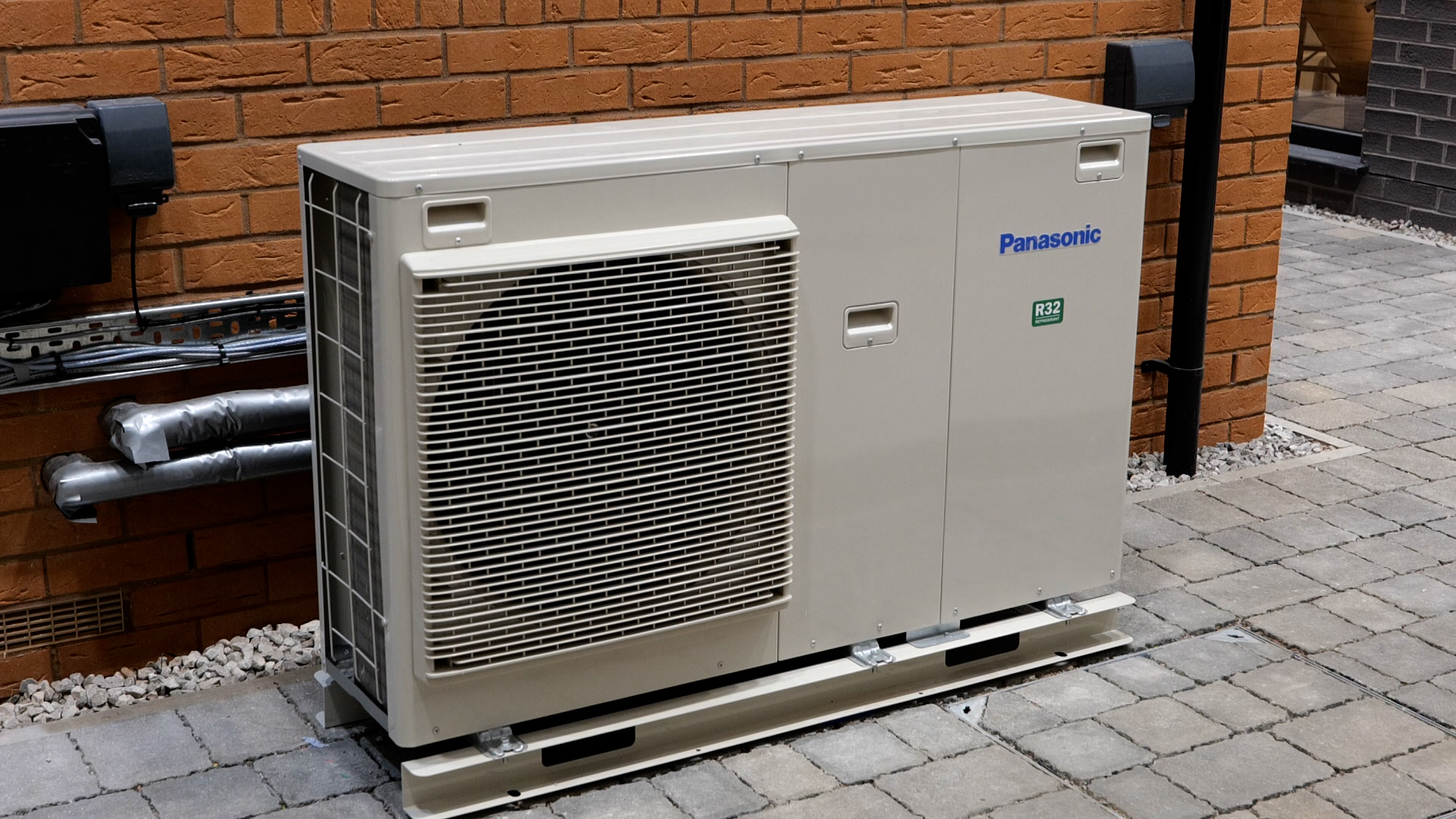
Panasonic Heating & Cooling Solutions has been helping with a study at the University of Salford and the Energy House 2.0 research project in conjunction with Bellway Homes. The research looks at the effects of the planned Future Homes Building Standard (FHS) and how this will impact on new build properties. This experimental eco home is a ground-breaking research study by the University, combining eco efficient processes to meet the impending Future Homes Standard (FHS) for new build houses. The research also tests how low-carbon technologies impact the cost of living. The Future Home at Energy House 2.0 is built by Bellway inside a climate-controlled chamber at the university. Panasonic is one of the manufacturers selected to power the heating with its Aquarea J Series air-to-water heat pump.
The UK Governments Future Homes Building Standard is due to be published in Autumn 2025, to significantly reduce carbon emissions from new homes by 75-80% (compared to current standards), by utilising mandatory low carbon heating systems such as heat pumps. Panasonic shared one of its research collaborations with the University of Salford alongside developers Bellway.
Panasonic has been involved in the Energy House 2.0 project with Bellway Homes and the University of Salford since its inception in 2022 with research starting at the beginning of 2023. Jamie Bursnell, Head of Technical and Innovations at Bellway shared that the Panasonic Aquarea air to water heat pump units were selected for the project due to their high energy efficiency and low running costs.
Results found that air source heat pumps can cost as little as £1.84 on a typical winter day to heat a home and are more efficient than current gas boilers1.
Professor Will Swan, Director of Energy House Laboratories at the University of Salford, said: “The innovation accelerator has been a great opportunity for academia and industry to work together on the UK priorities of Net Zero and energy efficiency. Panasonic has been a committed partner in contributing to the research and innovation, working closely with the Energy House lab team to help understand the performance of the product. We look forward to working on future collaborations.”
John Kellett, Panasonic’s UK and Ireland’s Country Manager further added, “We feel privileged to be a part of this crucial research study to monitor the efficiency of more sustainable processes in the home. With the Future Homes Standard legislation coming later this autumn, it is vital to offer alternative measures that not only meet the new legislation, but also provide cost effective, efficient performance for homeowners.”
Throughout the testing, the home was exposed to temperatures as high as 40°C and low as -20°C, recreating wind, snow, solar radiation and other weather to deliver results on extreme conditions. The facility has the capability to replicate over 95 percent of the world’s climatic conditions, ranging from the normal to the extreme. Panasonic’s J Series air-to-water heat pump delivers efficient heating, with an average water outlet temperature of 45°C, maximum output temperatures of 60°C, and operational efficiency down to -20°C.
Jamie Bursnell further commented: “The heating tests at Energy House 2.0 have accelerated our understanding of how new homes can be heated through electric sources. The comparison of different combinations of heating technologies working in a controlled environment has highlighted some highly efficient systems. We will now refine and test further, and the research will inform our work with new technologies on the live developments where these are already being trialled.”
For more information visit https://www.aircon.panasonic.eu or to find out more about the Bellway Homes or the research at conducted at Salford university and the Energy House 2.0 project.